


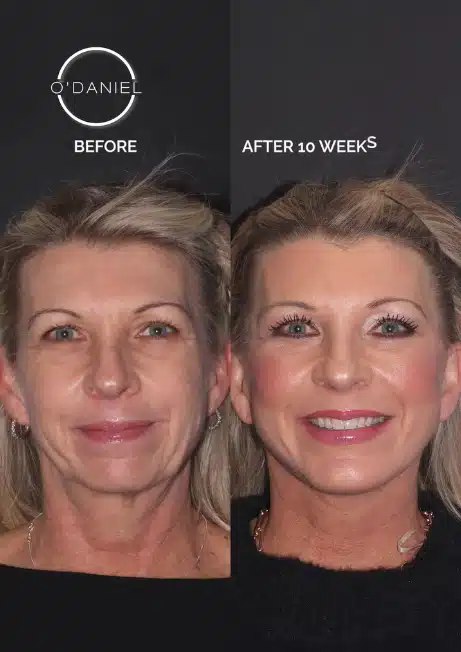
Ten weeks isn’t when I usually share results. Most surgeons wait longer, and honestly, for good reason. There’s still swelling at ten weeks. The face is still settling. But this case was different, and I felt it was worth an exception.
This patient came in at 53 wanting a real change. Not just a little tightening. A transformation. So we did five procedures in one operating session: a deep plane facelift, a deep neck lift, submandibular gland reduction, fat injections, and chin augmentation. Even at ten weeks out, the results were dramatic enough that I couldn’t wait until the one-year mark to share them.
I remember a consultation a few months ago where a patient came in after seeing a facelift result done elsewhere that just didn’t look right. The face was tighter but the neck was untouched, and the chin was never addressed. She told me it looked like a different person’s face sitting on top of the same old neck. That stuck with me. It’s exactly why I won’t do one part of the face in isolation when the whole picture needs attention.
Here’s what we did, why we did it, and what this kind of surgery actually involves.
Five Procedures. Why So Many?
The face ages as a system. Jowling, neck laxity, volume loss, a weak chin, and enlarged submandibular glands all interact with each other. Fix one and ignore the others and the result looks off. That’s not an opinion, that’s just anatomy.
For this patient, we mapped out every contributing factor and addressed them together. It’s the only way to get something that looks cohesive.
What We Actually Did
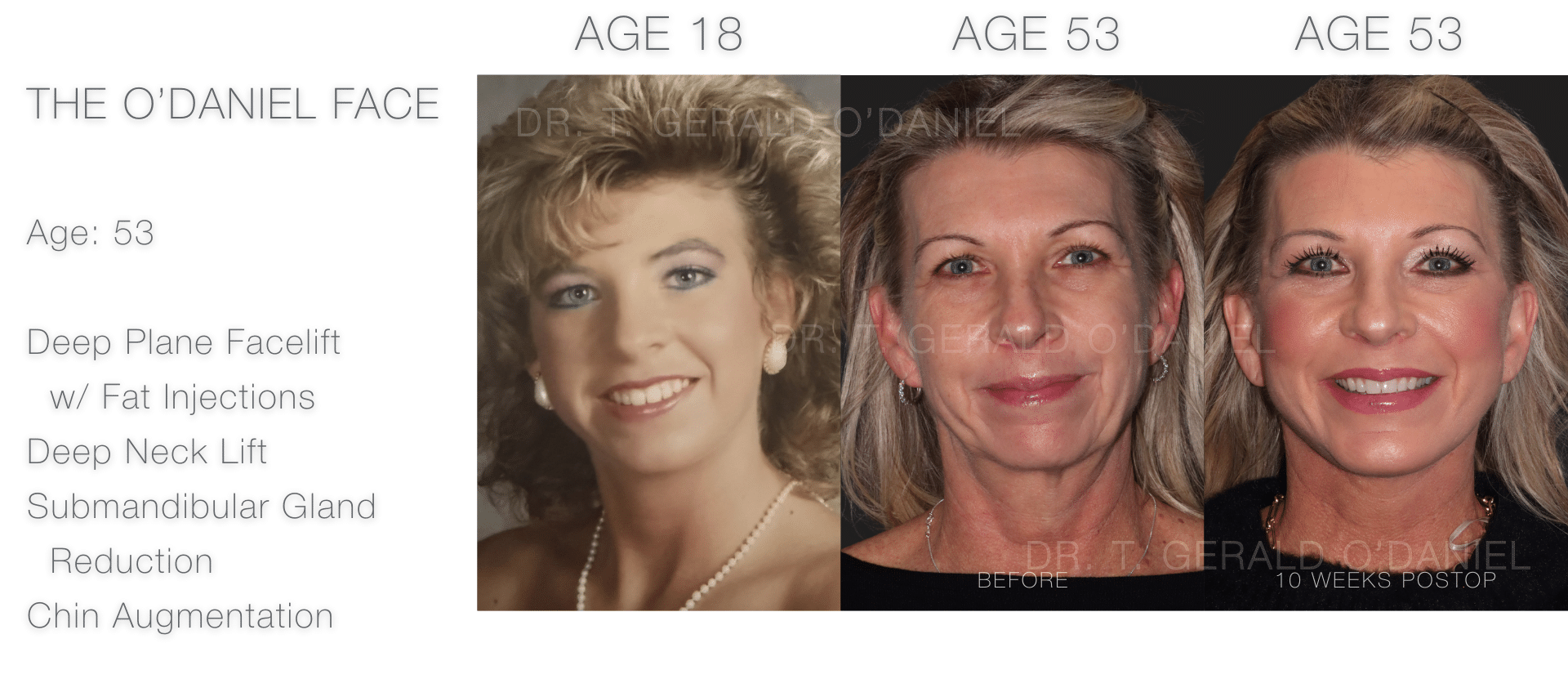
The Deep Plane Facelift
The foundation of everything. A deep plane facelift works below the SMAS layer, the muscular layer beneath your skin, to release, lift, and reposition tissues rather than just pulling skin tight. That distinction matters more than most people realize. Skin-only techniques tend to look pulled. Deep plane techniques look natural because the underlying structures are actually moving the way they’re supposed to.
At 53, this patient had jowling along the jawline and midface descent. The kind of changes that happen when deeper soft tissue starts to sag. The deep plane approach let us address that directly, repositioning tissue upward and backward to restore the contour he had when he was younger. Not a stretched version of his current face. His actual face, from a decade earlier.
The Deep Neck Lift
The neck is its own project, and you can’t treat it as an afterthought. A facelift addresses the face and lower face, but if you don’t treat the neck separately, you end up with a mismatch. A rejuvenated face sitting on a neck that still shows its age.
A deep neck lift works on the platysma muscle, tightening and reshaping the entire neck structure to create a clean cervicomental angle. That’s the sharp definition between the chin and neck that reads as youthful on pretty much every face. Without it, even a great facelift can look incomplete.
Submandibular Gland Reduction
Most people have never heard of this one. And it’s probably the most underappreciated part of neck rejuvenation.
Underneath the platysma muscle sit the submandibular glands, two salivary glands, one on each side. In some patients they’re enlarged or sit low, creating visible bulging in the neck that no amount of skin tightening or fat removal can fix. Won’t matter how good the facelift is. If the glands are prominent and you don’t address them, they’ll always show through.
This patient had gland prominence that would have compromised the neck result. So we reduced them. It’s technically demanding, but it’s what separates a genuinely clean neck from one that still has persistent fullness under the jawline. A 2025 systematic review in the Aesthetic Surgery Journal confirmed that gland reduction consistently improves cervicomental contour in patients where glandular bulk is the limiting factor, and that with proper technique, serious complications are uncommon.
I’ll be honest: a lot of surgeons skip this step because it adds complexity and time. I understand why. But for the right patient, skipping it means leaving a significant part of the result on the table.
Fat Injections (Fat Grafting)
The face doesn’t just sag as it ages. It also loses volume. The temples hollow out. Cheeks deflate. The under-eye area gets sunken. You can lift tissue all day, but if you don’t put volume back where it’s been lost, the result can look thin or slightly gaunt.
Fat grafting takes fat from elsewhere in the body, processes it, and injects it into areas that need volume restored. In this case we used it to soften the midface and improve the overall shape of the result. Lift plus volume is a fundamentally different outcome than lift alone.
Chin Augmentation
Chin projection has more effect on facial balance than most people expect. A weak or recessed chin shortens the face, makes the neck look fuller than it is, and throws off the harmony between the upper and lower thirds.
This patient’s chin wasn’t dramatically deficient, but it was limiting what we could achieve with the neck lift and facelift. Adding a chin implant changed the proportions in a meaningful way. The neck looks longer. The jawline looks stronger. The whole face reads differently, and it does so naturally, not surgically.
Ten Weeks Out. What That Actually Means.
I want to be direct: ten weeks isn’t the final result.
There’s still swelling at ten weeks, especially in cases with this level of complexity. The neck tends to stay puffy longer than the face. Some firmness and tightness is still resolving. Sensation may still be returning in places. All completely normal.
What you’re seeing in the photos is the early result. The structural changes are clearly visible, the transformation is obvious, but there’s still refinement ahead. Most patients aren’t fully settled until the four to six month mark. Some take longer.
So why share at ten weeks? Because the changes are real and significant even this early. And because I think it’s honest to show what healing actually looks like at different stages, not just the polished one-year photo.
Here is a general recovery timeline for a case like this one:
Week 1-2: The most intense part. Bruising, swelling, and tightness are at their peak. Rest is the priority.
Week 3-4: Bruising fades significantly. Swelling starts to soften. Most patients are comfortable going out in public.
Weeks 6-8: The result starts to become visible. Swelling is mostly down, though some residual puffiness in the neck can persist.
Week 10-12: This is where this patient is. Major transformation is clear. Fine-tuning still underway.
Month 4-6: Most patients reach their settled result. Skin continues to soften and conform.
One year: Final result. That’s when I take the official after photos for case documentation.
What the Research Says
I believe patients deserve to understand the evidence behind what they’re consenting to. So here’s what the literature actually shows.
A 2025 systematic review and meta-analysis by Khoury et al., published in Aesthetic Plastic Surgery, analyzed 21 studies with nearly 3,000 patients comparing deep plane and SMAS facelifts. Deep plane techniques showed a patient satisfaction rate of 94.4%. That’s among the highest reported for any facial rejuvenation surgery.
On the neck side, a 2025 systematic review in the Aesthetic Surgery Journal looked at submandibular gland reduction across 51 studies and nearly 3,000 patients. It found that gland reduction consistently improves cervicomental contour in patients with glandular prominence, and that with proper technique, major complications are rare. That lines up with what I see in practice.
Is This Level of Surgery Right for You?
Not every patient needs five procedures. Most don’t. The right plan depends entirely on what your face actually needs, not what’s trending, not what someone else had done.
What I can say is that when multiple issues are present and they interact with each other, addressing them together in one session almost always produces a better outcome than staging them separately. You heal once. The results work together. The harmony is there from the start.
If you’re in your 40s or 50s and thinking seriously about facial rejuvenation, the most important thing is a thorough consultation with a surgeon who does this at volume, who can look at your specific anatomy, and who will tell you what they actually think will work.
You can browse our full facelift case study library. You can also read more about my background here, including my invited lectures and academic work on facial rejuvenation techniques.
Come See Us
We’re based in Louisville, KY, but we see patients from all over the country. If you’re coming from out of town, we’ll walk you through how to make it work.
Financing options are available. Details here. And when you’re ready to talk, reach out at drodaniel.com/contact-us to schedule a consultation.
At 53, this patient didn’t settle. Neither should you.
View this post on Instagram
References
Khoury S, Almubarak Z, Khan H, et al. The Deep Plane versus SMAS Facelift: A Systematic Review and Meta-Analysis. Aesthetic Plastic Surgery. 2025;49(21):5895-5903. https://pubmed.ncbi.nlm.nih.gov/40801931/
Morel SBA, Macias LH, Chopra R, et al. Aesthetic Submandibular Gland Resection: A Review of Complication Incidence and Prevention. Aesthetic Surgery Journal. 2025;45(9):869-874. https://doi.org/10.1093/asj/sjaf096