


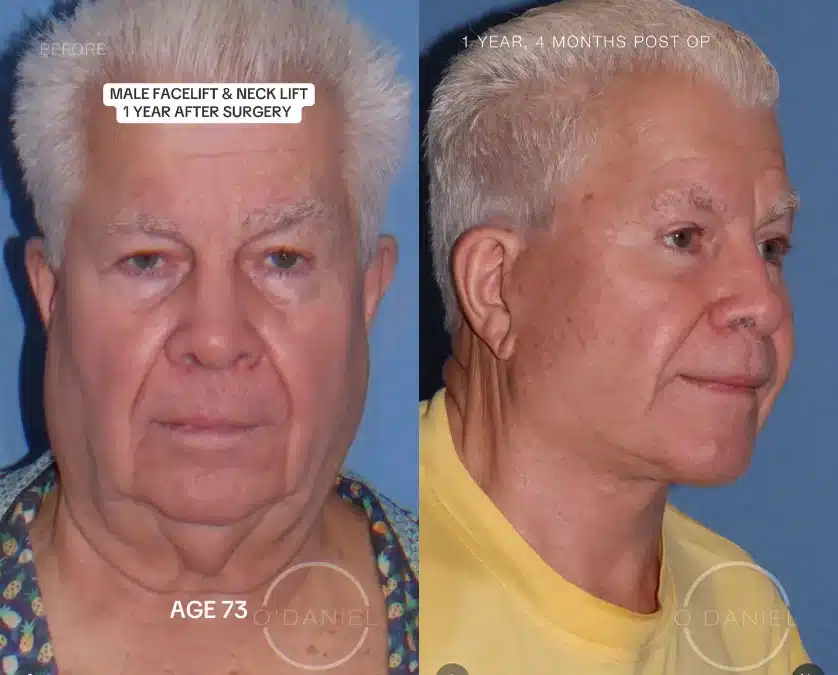
Age 73 is not a number most people associate with facelift surgery. And honestly, that’s part of what makes this case worth talking about.
We recently shared this patient’s journey on Instagram. A 73-year-old man who underwent a deep plane facelift and neck lift at O’Daniel Studios here in Louisville. The video shows him from immediately after surgery through to one year and four months post-op. The response was enormous. People couldn’t believe the transformation, and a lot of men reached out asking whether this kind of result was even realistic for someone in their 70s.
So let’s talk through it. The patient, the procedure, the healing, and what the results actually look like after more than a year. No fluff, just the real picture.
Isn’t 73 Too Old for This Kind of Surgery?
This is the first question people ask, and it’s a fair one. Short answer: age alone isn’t the disqualifier. Health status is.
This patient came in excellent overall health. No major cardiac issues, non-smoker, realistic expectations, and a genuine understanding of what recovery involved. When those boxes are checked, age becomes much less of a barrier than most people assume.
That said, operating on a 73-year-old man is genuinely different from operating on someone 20 years younger. The skin is thinner. Tissue behaves differently. The underlying anatomy has changed more dramatically over decades. And with male patients specifically, there are technical considerations that don’t apply to women. Thicker skin, a more prominent beard pattern, different aesthetic goals around jawline definition and neck contour. These aren’t minor details. They demand a surgeon with real experience in male facelift surgery, because not every surgeon who does facelifts does male facelifts well.
I’ve been doing this for over 30 years. You can read more about my background and training here. Male patients make up a meaningful portion of my practice, and this case pushed me in the best possible way.
What We Actually Did: Deep Plane Facelift and Neck Lift
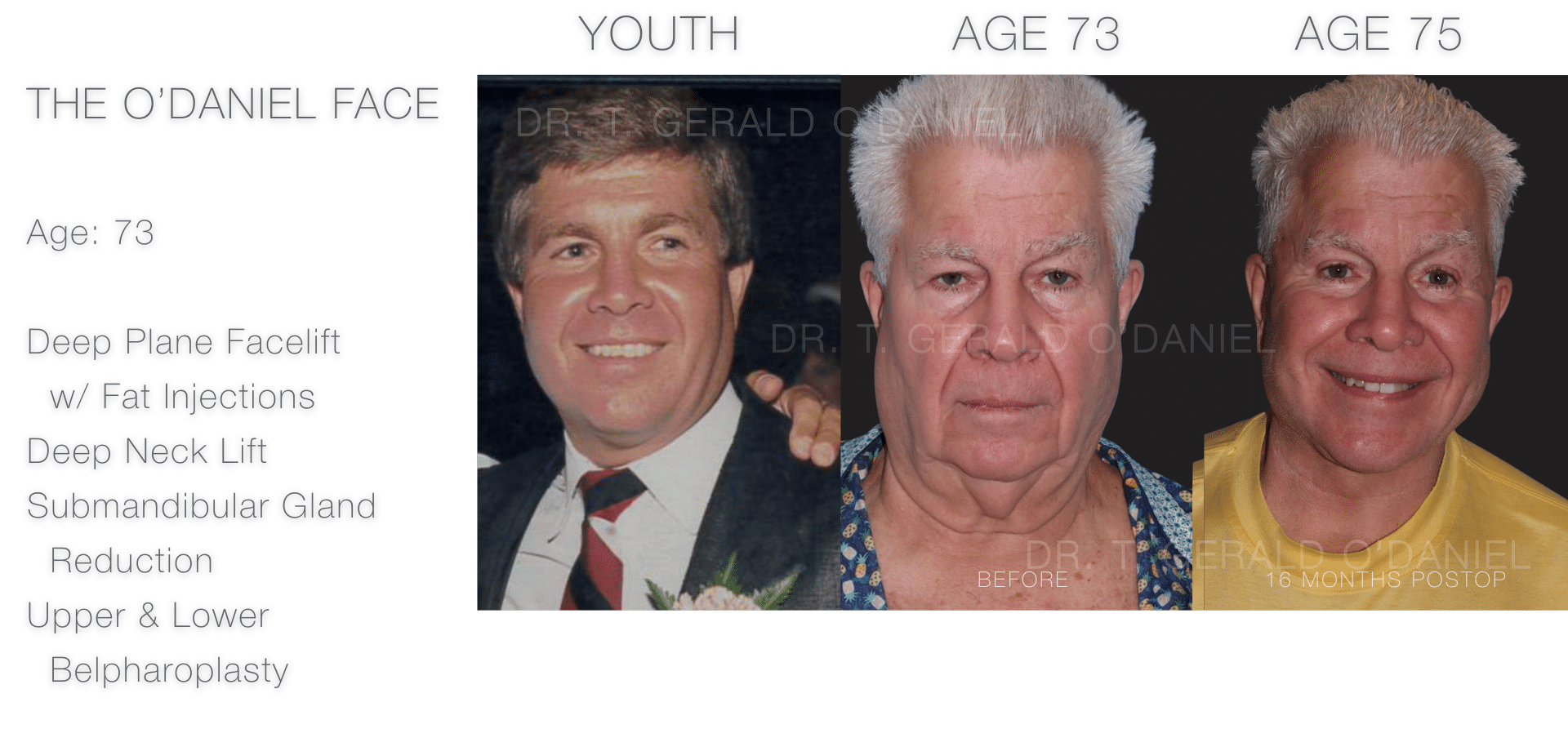
Let me walk through exactly what this procedure involved, in plain terms.
The Deep Plane Approach
A deep plane facelift works at a fundamentally different level than older techniques. Rather than pulling the skin tight (which is what gives people that stretched, obvious-looking result), we go below the SMAS layer. That’s a sheet of tissue connecting the facial muscles to the skin. By releasing the deeper structural attachments and lifting the skin, fat, and muscle together as one unit, we can create a genuinely natural repositioning of the face.
Here’s the thing a lot of patients don’t realize: with an older face, the temptation is to compensate for sagging by pulling the skin harder. That’s exactly backwards. It doesn’t fix the problem. It just makes you look like you’ve had a bad facelift. The deep plane lets us move the actual tissue back to where it was, rather than stretching skin over a structure that hasn’t changed. The result looks like time was reversed, not like surgery was done.
For a 73-year-old man, the jowling, the heaviness in the lower face, the loss of jawline definition. All of that gets addressed at the structural level, not the surface.
The Neck Lift
The neck matters enormously in male patients, maybe even more so than in women. That clean angle between the chin and neck, what surgeons call the cervicomental angle, reads as strong and youthful. By the time a man reaches his 70s, that definition is usually long gone. Excess skin, platysmal banding, submental fullness. It all piles up. You can see what a properly executed neck lift looks like across our case study gallery.
We tightened the platysma muscle, sculpted the neck contour, and restored that jaw-to-neck transition. It’s one of the most satisfying parts of this type of case because the change is so visible and so impactful on overall appearance.
I’ve lectured internationally on deep neck lifting techniques. It’s an area where I’ve spent decades refining my approach, and with male patients, getting the neck right isn’t optional.
Why Both Together?
You rarely get good results from one without the other. Lift the face but ignore the neck and the transition between them looks disconnected, even artificial. Done together properly, they create something cohesive. A rejuvenated face that flows naturally into a defined neck. That’s what this patient got, and it’s why the result reads as natural rather than surgical. If you want to see how this looks across different patients, our male facelift and neck lift gallery is worth a look.
Recovery: From the Operating Table to 16 Months Out
The Instagram video shows the full arc of this patient’s recovery, and I want to be straight with you about what that looks like, because I think a lot of people go into this process underprepared.
Right after surgery, you won’t look good. The early part of the video makes that clear. There’s bruising, swelling, and the face looks very different from how it will ultimately settle. That’s normal. It’s expected. But it can be alarming for patients who weren’t told what to expect, which is why I spend real time during consultations walking through each phase of healing, not just the end result.
Here’s a rough timeline. In the first week, most patients are resting at home, managing swelling and discomfort with medication. By week two, a lot of the bruising has faded and while there’s still visible swelling, it’s not dramatic. By weeks six to eight, patients are largely back to normal life. Work, social events, most of their regular activities.
But the full result? That takes longer. Swelling continues to resolve over months. Tissue settles into its new position. Scars mature and fade. I tell every patient: the result you see at three months is not the final result. The result in six months is closer. What you see in one year, or in this case one year and four months, is what you actually got.
And what this patient got is striking. The jawline is defined. The neck is clean. The lower face has genuine structure again. He looks like a significantly younger version of himself. Not a different person, not someone who obviously had surgery. Just himself, from a decade or more ago. That’s what we’re going for every single time.
I’ll also say this: he was an excellent patient. He followed post-op instructions carefully, showed up to every follow-up, and was patient with the process. That matters more than people think. Good surgery plus a diligent patient equals great results.
What the Research Says
I believe patients deserve to understand the evidence behind the procedures they’re considering. Deep plane facelift techniques aren’t experimental. They have decades of clinical data behind them, and the research published in the last couple of years is particularly strong.
Study 1: Male Deep-Plane Face and Neck Lifting, Advanced and Customized Techniques
Published in Facial Plastic Surgery Clinics of North America in 2024, this study by Bray and colleagues focuses specifically on the unique considerations of deep plane facelifts and neck lifts in male patients. The authors found that vertical vector deep-plane surgery produces more durable and natural results in men, with less reliance on volume addition techniques. Crucially, they also document how proper extended deep-plane technique avoids the telltale scar patterns and stigmata of surgery seen with more superficial approaches. That’s the exact philosophy behind how we approached this case.
Read the full study: PubMed, PMID 38936991
Study 2: The Deep Plane versus SMAS Facelift, A Systematic Review and Meta-Analysis
Published in Aesthetic Plastic Surgery in August 2025, Khoury et al. analyzed studies from 2000 to 2024 comparing SMAS and deep plane facelift outcomes across thousands of patients. The findings confirm what experienced surgeons have observed clinically for years. Deep plane techniques consistently deliver stronger long-term results and higher patient satisfaction, particularly for patients with more advanced facial aging where surface-level approaches can’t achieve adequate repositioning. For a 73-year-old man with significant accumulated facial changes, the deep plane isn’t just preferable. It’s the right call.
Read the full study: PubMed, PMID 40801931
Could This Work for You?
If you’re a man in your 60s or 70s looking at this case and wondering whether something similar is realistic for you, here’s my honest take.
The first thing I look at isn’t your age. It’s your overall health, your skin quality, and the specific anatomy of your face and neck. A 73-year-old in excellent health with realistic goals can absolutely achieve dramatic results. This patient is proof of that.
What I’d also tell you is that the surgeon you choose matters more than almost anything else in this process. Male facelifts are technically different from female ones. The incision placement, the approach to the beard pattern and hairline, the aesthetic targets around jawline and neck definition. These require someone who operates on men regularly and understands what a natural male result looks like. Get it wrong and you end up looking feminized or obviously operated on. Get it right and you get what you see in that video. Take a look at our full facelift case study library to see the range of results we achieve across different ages and face types.
About one in three patients who come to see me are seeking revision surgery after going elsewhere and not getting the result they hoped for. I see this constantly. It’s one of the harder parts of this job, and it’s why I can’t stress enough how much surgeon selection matters. Don’t choose based on price. Choose based on results.
Come See Us in Louisville, or Wherever You Are
We see patients from Louisville and the surrounding area, but also from across the country and internationally. If you’re coming from out of town, we have a streamlined process for that and it’s something we do regularly. The first step is a real conversation, one where I can actually evaluate your anatomy and tell you honestly what’s achievable.
Financing options are also available if cost is a consideration. You can learn more about that here.
Schedule a consultation at drodaniel.com/contact-us, or call 502.584.1109. We’re at 132 Chenoweth Lane, Louisville, KY 40207.
Follow @dr.tgeraldodaniel on Instagram to see more cases like this one.
At 73, this patient didn’t settle for looking his age. You don’t have to either.
Individual results vary. The outcomes described here reflect one patient’s experience and are not a guarantee of results for any other patient. All surgical procedures carry risk. A personal consultation with Dr. O’Daniel is required to determine candidacy.